For excerpts from the 2000 Physical Activity Monitor, click here For facts on Physical Activity
and Student Learning click here
For
the National Longitudinal Survey of Children and Youth: Childhood Obesity
click here
For excerpts from the 2000 Physical Activity Monitor, click here For facts on Physical Activity
and Student Learning click here
For
the National Longitudinal Survey of Children and Youth: Childhood Obesity
click here
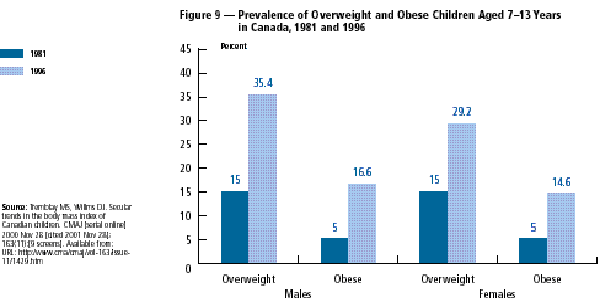
 The percentage of overweight boys increased from 15% in 1981 to 35.4% in 1996
The percentage of overweight girls increased from 15% in 1981 to 29.2% in 1996
The percentage of obesity in children tripled over that period of time, from 5% to 16.6% for boys and from 5% to 14.6% for girls
Source: Tremblay, Mark S. and J. Douglas Willms, 2000, Secular Trends in the Body Mass Index of Canadian Children. Canadian Medical Association Journal. Vol. 163, No. 11, 1429-1433.
 25% of Canadian children are considered to be overweight
Two-thirds of Canadian school-aged children are not active enough for optimal development and they become more inactive as they get older
Source: The Progress of Canadian Children 2001, Canadian Council on Social Development.
- Physical activity reduces stress, strengthens the heart and lungs, increases energy levels, helps you maintain and achieve a healthy body weight - and it improves your outlook on life.
Source: Health Canada, 2002
 A recent study by the Canadian Medical Association Journal showed that the average Canadian child is inactive for three to five hours a day in front of the TV alone. This does not include the five to seven hours most children spend sitting in school five days a week
Source: Canadian Medical Association, 2000.
-
The likelihood that children will never smoke is directly related to the amount of physical activity; more than 80% of Canadians between the ages of 10 and 24 who are active have never smoked
Girls who are physically active in sports are 92% less likely to use drugs and 80% less likely to have unwanted pregnancy
A 1998 Gallup poll reported that 74% of the Canadian population is in favour of instituting 30 minutes of daily physical education in schools. Despite this fact, only 10% of the 15,800 Canadian schools have quality physical education programs daily
Source: The Canadian Fitness and Lifestyle Research Institute, 1999, Sport Nova Scotia, 1997, and The Canadian Association for Health, Physical Education, Recreation and Dance, 1998.
-
The amount of time spent playing video games by Canadian children is among the highest in the world
Source: Health Behavior in School-aged Children, Research Unit in Health and Behavioral Change, 2000.
-
Canadian children are becoming continuously fatter, weaker and less flexible
Source: The Canadian Fitness and Lifestyle Research Institute,1998.
-
Only 15% of teenagers exercise enough to be physically fit
The average child watches 26 hours of TV each week, not including time spent on the computer and playing video games
Source: 1997 Physical Activity Benchmarks Reports, Canadian Fitness and Lifestyle Research Institute and the 1998 Campbell Survey on Well-Being in Canada.
-
Being physically active on a regular basis can reduce by 50% the relative risk of contracting Non-insulin Dependent Diabetes
Source: Journal of American Medical Association, 1992.
-
Physical activity on a regular basis can increase a person's average life expectancy by as much as two years
Source: Paffenbarger, 1986.
-
Regular physical activity can help prevent and limit the effects of heart disease and strokes
Source: Heart and Stroke Foundation of Canada, 1993.
-
Two national studies by the Heart and Stroke Foundation and the Canadian Fitness and Lifestyle Research Institute found that the health of 63% of Canadian children are threatened because of high levels of physical inactivity
Source: Heart and Stroke Foundation, Canadian Fitness and Lifestyle Research Institute, 1997.
-
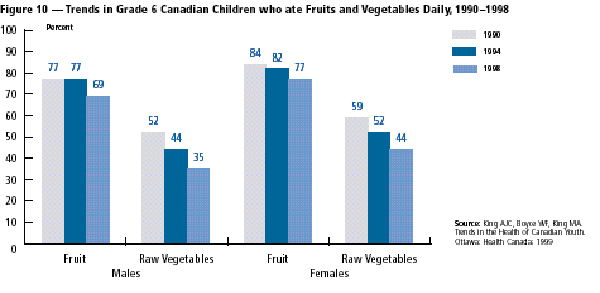
The risk factors for obesity are increasing among Canadian children. The proportion of children who ate fruit and vegetables daily and exercised outside school hours decreased steadily between 1990 and 1998
Source: King AJC, Boyce WF, King MA. Trends in the Health of Canadian Youth. Ottawa: Health Canada; 1994.
-
Children who are overweight have an increased risk of becoming obese as an adult, and are at higher risk of early adult diseases and mortality
Inactivity leads to doubling the risk of developing heart disease as compared to those who exercise regularly
Approximately 36% of heart disease cases are a result of inactivity. If everyone became active, the incidence of heart disease would be cut by more than a third
Source: Peter Katzmarkzyk, York University School of Kinesiology and Health Science, 2000.
-
42% of children almost never participated in organized sports such as soccer, basketball, hockey, baseball and football
Only 44% of Canada's children between 4 and 11 years old were sufficiently active for health
17% of Canadian children are sedentary and only participate in physical activity once a month at best
39% of Canadian children are considered somewhat active
Approximately 70% of children play computer games at least weekly
24% of children played computer games most days
52% of children aged 4 and 5 played computer games at least once a week while 74% of 9 year olds and 78% of 10 and 11 year olds played at least once a week
22% of youth who did no exercise or play sports outside of school watched four or more hours of television per day as opposed to 13% of youth who exercised or played sports seven or more hours per week
Source: Canadian Fitness & Lifestyle Research Institute, Canada's Children and Youth: A Physical Activity Profile, 1999.
-
Less active and less fit people have a 30-50% greater risk of developing high blood pressure
In North America, 40% of 5 to 8 year old children can be classified as obese
40% of Canadian children already have developed at least one risk factor for heart disease - reduced fitness due to inactivity
Source: Fishburne, G.J. & Harper-Tarr (1992). An analysis of the typical elementary school timetable: A concern for health and fitness.
-
Activity and fitness levels early on in childhood carry over into adulthood, when sedentary habits have their impact
Source: Blair, S.N. (1992). Are American children and youth fit? The need for better data. Research Quarterly for Exercise and Sport,63(2): 120-123.
-
In 1 minute with 45 to 50 beats, the heart of a fit person pumps the same amount of blood as an inactive person's heart pumps in 70 to 75 beats. Compared to the well-conditioned heart, the average heart pumps up to 36,000 more time per day - 13 million more times per year!
Adolescents who develop a habit of being physically active when they are young will be more likely to remain active throughout their entire lives
Source: Sallis, J.F. & Patrick, K. (1994). Physical activity guidelines for adolescents: Consensus statement. Pediatric Exercise Science,6: 302-314.
-
Children and teenagers who are physically active have lower levels of smoking and alcohol consumption than those who are inactive
Source: Campbell (1988). Campbell's survey on well-being. In Fitness Directorate (Ed.) Active living and health benefits and opportunities. Ottawa: Canadian Association for Health, Physical Education, Recreation and Dance.
-
Benefits of continual physical activity include weight control, lower blood pressure, less stress, lower risk of heart disease and better academic performance
Source: Heart and Stroke Foundation of Canada (1993). Position statement on Physical Activity. Unpublished Report, Ottawa.
-
Regular physical activity is associated with a reduction in all-cause mortality, fatal and non-fatal total cardiovascular disease and coronary heart disease. It is also associated with a reduction in the incidence of type 2 diabetes, colon cancer and osteoporosis
Thirty minutes of moderate physical activity daily is associated with a 30% reduction in all-cause mortality rates
Source: Health Canada, 2001.
-
Physical Inactivity Levels in Canada by Province and Territory
Province
Population
Children and Youth
Newfoundland
65%
61%
Prince Edward Island
65%
54%
Nova Scotia
62%
52%
New Brunswick
64%
54%
Quebec
62%
70%
Ontario
59%
54%
Manitoba
66%
47%
Saskatchewan
69%
51%
Alberta
63%
57%
British Columbia
56%
48%
Northwest Territories
56%
54%
Nunavut
65%
56%
Yukon
58%
51%
Source: Health Canada, 2001.